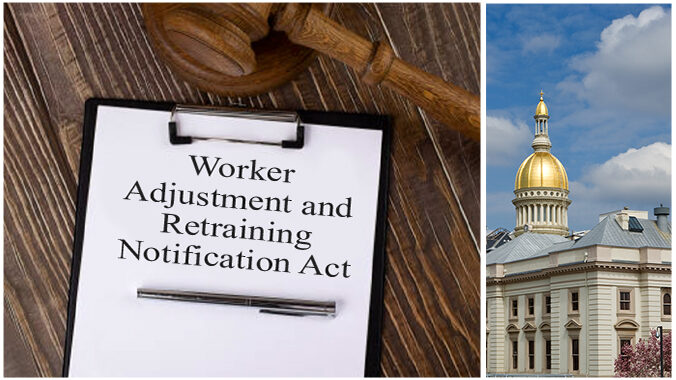
What is the New Jersey WARN Act:
The New Jersey WARN Act was established to protect workers, their families and communities when corporations seek to lay off employees. The New Jersey WARN Act is similar to the Federal WARN Act (Federal Worker Adjustment Retraining and Notification Act of 1988), however, the NJ WARN Act imposes more stringent requirements for employers.
Updates to the New Jersey WARN Act:
On April 10, 2023, Governor Phil Murphy of New Jersey enacted amendments to the NJ WARN Act that impose specific obligations and standards on employers in New Jersey. The amendments have heightened the employer requirements during layoffs, including mandatory severance and longer notice periods, and now cover more employers than the prior version of the act.
The following is a summary of some of the significant revisions to the NJ Warn Act:
90 Day Notice Obligations. Employers with 100 or more employees must provide at least 90 days advance notice (the prior standard was 60 days as required under the Federal WARN Act) to impacted employees before terminations due to a mass layoff, termination of operations, or transfer of operation.
Mandatory Severance. Employers must provide discharged employees with severance pay equal to one week of pay for each full year of employment. The severance obligation applies even if the employer provides the employees with the proper advance notice. This is a significant change from the prior act, which only required severance if the employer fails to comply with the advance notice obligations.
Threshold for mass layoffs. The revised Act requires notice under more circumstances than the prior Act. The revised law now requires notice whenever there is a mass layoff impacting at least 50 employees working at or reporting to a location. This is true even if the total number of employees does not comprise at least 33% of the employees at the worksite location, which was the standard under the prior version of the Act.
Expanded Counting and Coverage of Part-Time Employees. The revised Act now requires employers to count part-time employees in determining both the count for purposes of whether the entity is a covered employer (100 total employees) and whether there is a mass layoff (at least 50 employees). As a result, employers must provide part-time employees with the 90 days' advance notice and severance pay, just like full time employees.
Expanded statewide definition of "Establishment." The revised Act expands the definition of "establishment" to a single location or a group of locations, so that employers must now combine their locations in New Jersey in determining the 50 employee threshold.
Corporate Strategy for handling the requirements of the revised NJ WARN Act:
Whether your corporation is a foreign corporation doing business in New Jersey, or a domestic corporation, you need to be fully aware of the requirements of both the Federal WARN Act and NJ WARN Act. Penalties for failing to comply with the Federal and State WARN Act can subject companies to significant penalties and liabilities. Every corporation needs to have a full understanding of the Acts and have a WARN Act policy in place to address any significant employee layoffs.
Contact MKC Law Group for a consultation on the Federal and State WARN Act requirements to discuss the implementation of a WARN Act policy with your corporation.
DISCLAIMER: This is only a summary overview and is not intended to be a full analysis of the NJ Warn Act or its recent updates. Always consult with an attorney before making any decisions. For a full consultation on the NJ Warn Act, please contact our office to schedule a consultation with an attorney.
2 Executive Drive, Suite 240
Fort Lee, New Jersey 07024
Ph: (201) 947-5200
Fx: (201) 708-6676
300 Hudson Street, Suite 10
Hoboken, New Jersey 07030
Ph: (201) 203-7476
Fx: (201) 708-6676
32 East 57th Street, 8th Fl.
New York, New York 10022
Ph: (212) 726-1104
Fx: (212) 726-3104
Consultations are by appointment only
National Languages





English | Korean | Chinese | Spanish